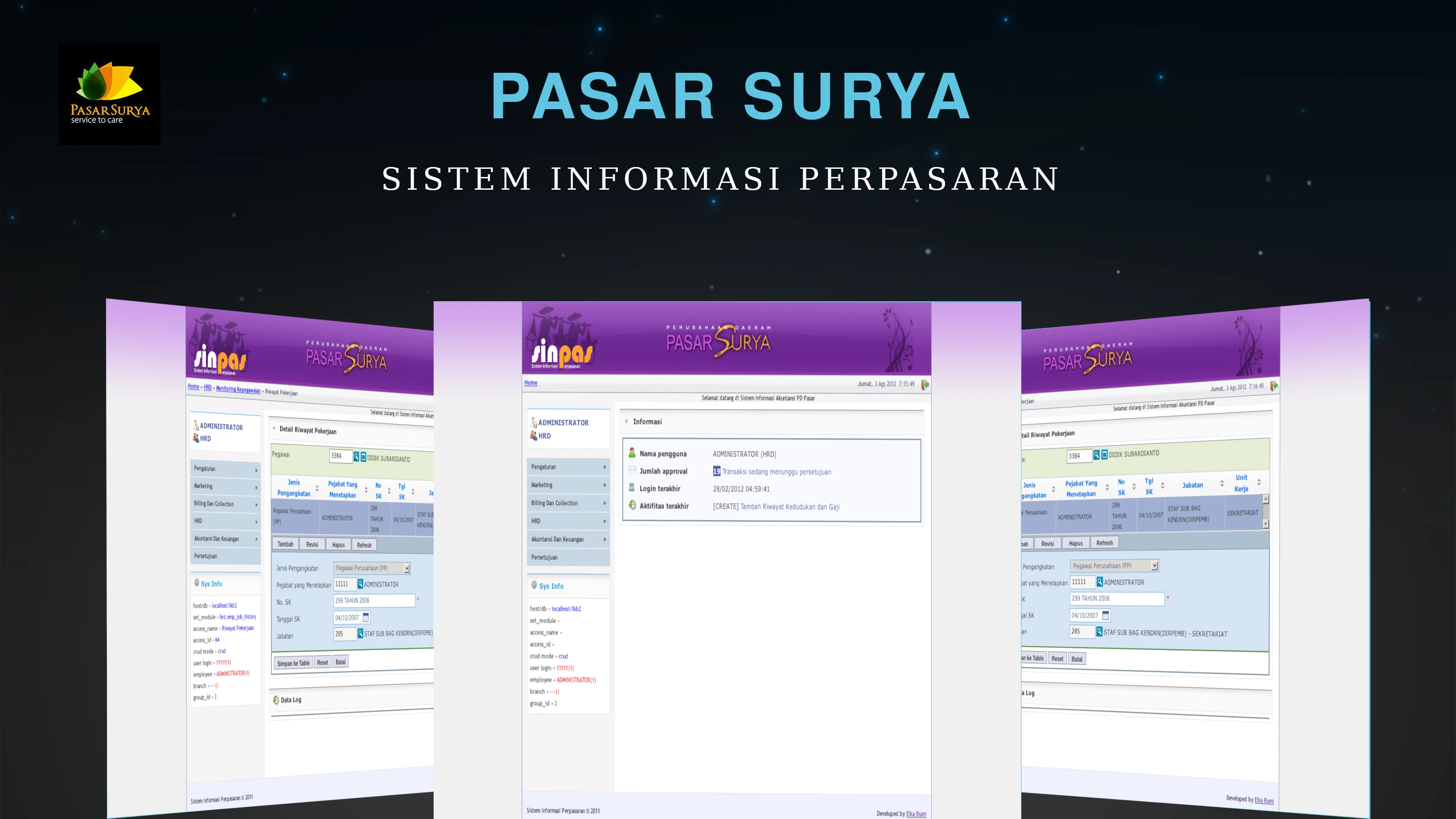
Impactful Works
Dika Karya Tech's expert team is ready to help design, develop, and launch your web or mobile applications!
Custom Software & Application Development
Simply put, Custom Software Development is the process of designing and creating software specifically tailored to the deep and specific business needs of a company. Choosing custom development is the best path if your business requires unique specifications that off-the-shelf products cannot fulfill.
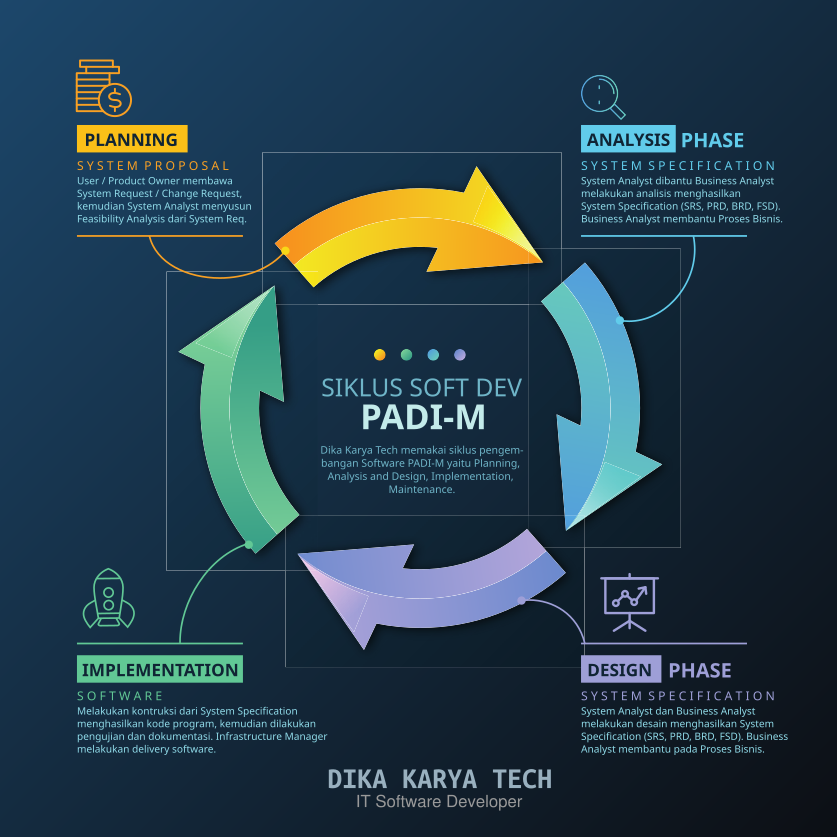
In its process, custom software creation can be handled by an internal developer team or outsourced to a specialized third party. The development cycle at Dika Karya Tech utilizes the PADI-M framework (Planning, Analysis and Design, Implementation, Maintenance).
Planning: The initial stage to decide whether the proposed system is feasible to develop. At this phase, the product owner brings the system requirements, followed by the creation of technical feasibility, economic feasibility, and organization feasibility assessments.
Analysis: Requirement gathering conducted before development begins. The goal is to ensure exactly what the users need within the system. In this stage, System Analysts are supported by Business Analysts.
Design: This stage produces the program design, which includes the deployment diagram, user interface design, data model, and class diagram as part of the system requirements specification.
Implementation: In this phase, the system requirement specification is handed over to programmers for construction (coding). The result is the program code, which is then passed to software testers for system verification. Afterward, a change management analyst ensures adequate documentation and training.
Maintenance: The cycle returns to the beginning if there are requests for changes or updates to the software already in use.
-
PADI-M Software Development Life Cycle
-
Targeted Solutions
A key reason to invest in Custom Software is the ability to solve specific business bottlenecks. Every business is unique; it is common for a company to prefer building its own software because it can be fine-tuned to their specific processes, leading to much higher efficiency and long-term success. -
Increased Productivity
Tailored software ensures the best, most efficient solution for your team. Employees can share data securely across departments, and multiple processes can be easily integrated into a single centralized system. -
Seamless Integration
New software development creates an environment that facilitates easier integration with other existing software. Custom software is designed to avoid integration issues, extending the functionality of existing systems to optimize workflows. -
Cost-Effectiveness
Setting a budget for innovation is crucial. While Commercial Off-The-Shelf (COTS) software might seem cheaper initially, hidden costs for training, licensing, and modifications often exceed the budget. Custom development is a more cost-effective decision when considering long-term benefits and features that actually matter. -
Enhanced Business Security
Data is a valuable asset. Keeping it safe from hackers is a top priority. Custom software is built with high-level security features specifically designed to protect your sensitive data from leaks and unauthorized access. -
Greater Scalability
As your business grows, so do your needs. While COTS software might struggle to support your growth or charge high fees for new features, custom software allows you to scale cost-effectively and on your own timeline. -
Independence without Vendor Lock-in
When you buy COTS software, you depend on the developer company. Their pricing, terms, and future are out of your control. If they stop updating the product, you are in trouble. With Custom Software, you own the solution and can use it for as long as you need.
IT Consulting and Digital Transformation
Through end-to-end digital transformation services, we help companies adopt new technologies, improve operational efficiency, and drive fundamental changes for sustainable business growth.
Digital transformation involves shifting business activities that were previously manual to digital, IT-based processes. Typically, this change occurs across all organizational lines, from administration and support to core business.
Digitalization brings an era of digital economy that is effective (fast), efficient (cheap), and transparent. International Data Corporation (IDC) predicts that 33% of global companies will face bankruptcy if they do not immediately adopt cloud technology and undergo digital transformation.
In the business world, digital transformation is essential to stay competitive. Startups are already implementing technology to compete with established companies. Besides cloud and data centers, the Internet of Things (IoT) remains a vital topic for supporting digital business.
Of course, this transformation cannot be done haphazardly. Without proper guidance, organizational stability can be disrupted, causing confusion from the board of directors to the execution team.
-
System Analysis and Study
Our consultants analyze which sectors and divisions can be transformed. From accounting to HR and sales, every aspect is carefully studied. -
Redesigning and Simplifying Existing Systems
Established companies already have existing systems. Our task is to re-formulate and simplify these systems for better digital efficiency. -
Implementing Necessary Automation
Software needs to be configured for automation that fits your specific needs. Our consultants handle this implementation directly. -
Post-Implementation Support
We are committed to long-term support. We ensure that changes are well-integrated and our team remains ready to help you maximize the results of the transformation. -
Collaborative Partnership
We believe digital transformation is a collaborative effort. We work closely with your internal team, ensuring a deep understanding of your company's vision and values.

IPPBX / VoIP Server Integration
Implementing digital and internet technology for internal, external, and inter-branch communication that is secure, efficient, and resilient.
IP PBX (Internet Protocol Private Branch Exchange) is a telephony switching system that uses IP technology. It controls both analog (TDM) and IP Phone extensions. Its functions include call switching, communication protocol translation, media transcoding, and controlling IP Telephony devices like VoIP Gateways.
IP PBX solutions are part of the Next Generation Network (NGN) concept, integrating conventional networks (PSTN), mobile networks (GSM/CDMA), satellite, and IP-based packet networks.
-
Easy Management and Usage
-
Rich and Useful Features
-
Guaranteed Security
-
Unified Communication
-
Remote Management
-
Perfect Integration
Process Automation and System Integration
Using technology to perform repetitive tasks or processes within a company. A System Integrator is a series of processes connecting several computerized systems and software applications, both physically and functionally.
Here are some benefits of system integration and automation:
-
Increased Productivity
Integrated systems allow centralized control, making workflows more efficient. When employees finish work faster, productivity rises, benefiting the entire company. -
Faster Decision Making
System integrators help companies access data that is no longer scattered across different storages. Analysis becomes faster as there is no need for manual downloads or extraction. -
Cost Effectiveness
Beyond saving time, system integration keeps production costs efficient. Companies don't need to spend on unnecessary infrastructure for individual systems. -
Improved Communication
Enhanced communication between internal departments and external participants.